← → to navigate
Understory · Onboarding

Who we serve

An introduction to our Ideal Customer Profile — the one definition that product, sales, CS and marketing all work from.

Why bother defining it

Focus is the mechanism

We keep the ICP deliberately narrow. Saying no to the edges is a feature of the definition, not a limitation of it — it's what lets us go deep instead of spreading thin.

One shared definition

Product, sales, CS and marketing optimise for the same customer instead of four different ones.

Sell efficiently

Find and qualify the right leads, run a message that resonates, keep acquisition cost down.

Build deep, not shallow

A focused roadmap wins on fit rather than feature count.

Built from 1,360 deals analysed. Most importantly it gives us a working decision filter — something we can measure plans and priorities against, rather than a description we file away.

If you remember one thing

The fit test

An owner-led tours, workshops, or Food & Beverage operator in DK, NO, SE, IT, or ES selling a scheduled, catalog-based experience, from Seed through Accelerate.

Five clauses. The rest of this deck unpacks one at a time — then we'll test them.

Clause 1 · Who

Three kinds of business

We group them by how a host earns their living, not by industry.

CodeCategoryWhere the value sitsThe guest asks
TOURGuided ToursThe journey, destination, or environment"Where are we going?"
INSTRInstructor-led WorkshopsDoing or learning something, with a defined end point"What will I learn?"
FBFood & BeverageThe product is the anchor"What will I taste?"

If you can answer the question in the last column, you can usually place the host.

Category · TOUR

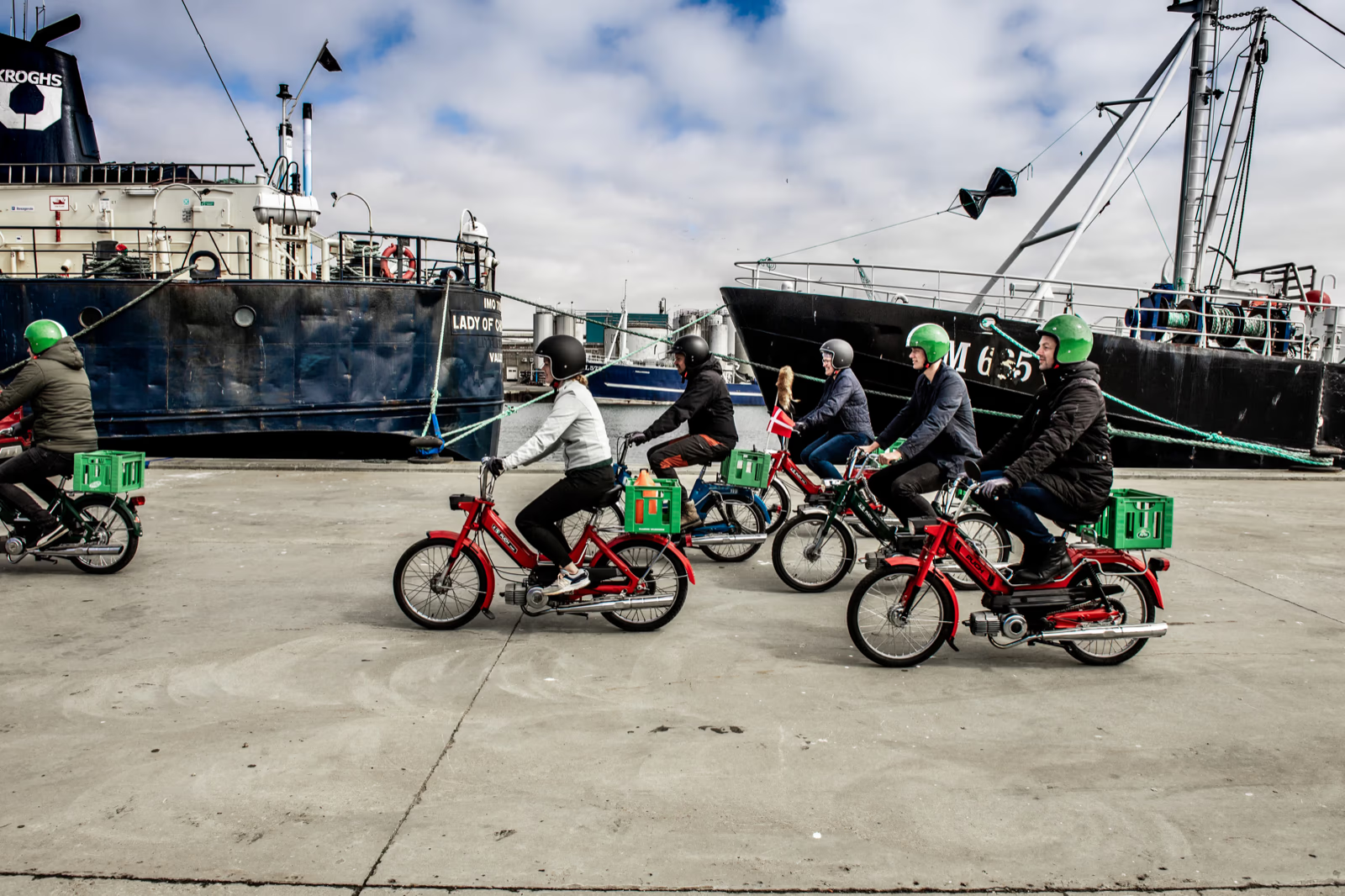
Guided tours

img/tours.avifimage unavailableA guided tour in progress
  • Capacity is set by a physical asset — the boat, vehicle, route or guide. You cannot oversell it.
  • Mostly tourists, often international. Median booking window 72 hours; 40% book within 24.
  • 30–70% through OTAs (GetYourGuide, Viator) alongside their own site.
  • Severe seasonality — Nordic peak May to September, near-zero off-season.
  • Weather drives cancellations and mass rebooking. That's normal operations, not an edge case.

Growth comes from adding departures, not seats.
Biggest gap: OTA channel depth, and commission we mostly cannot see live.

Category · INSTR

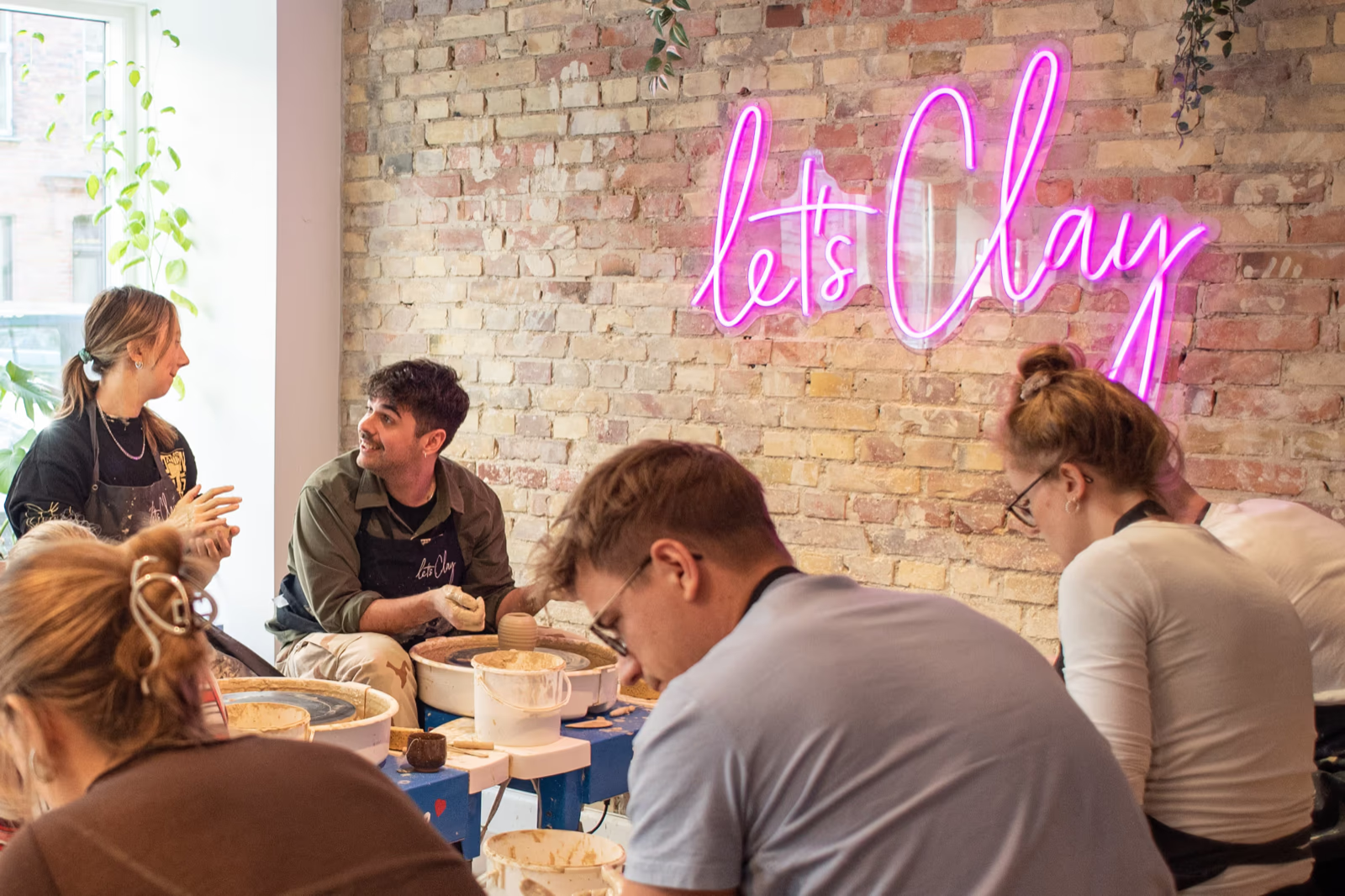
Instructor-led workshops

img/instr.avifimage unavailableA hands-on workshop in progress
  • Hands-on instruction by the founder or a craft expert. Small groups, 5–15 people, fixed location.
  • Capacity capped by space, tools, materials or instructors.
  • ~70% direct through their own site; ~20% gift cards and referrals.
  • Calendar published 4–8 weeks ahead, same workshop repeating through the season.
  • Modest seasonality, with a heavy Christmas gift-card spike.

The line that matters: value is delivered fully in one sitting. That's what separates a workshop from a yoga studio or a language course.
Biggest gap: the private and B2B flow — most operators still run it in email.

Category · FB

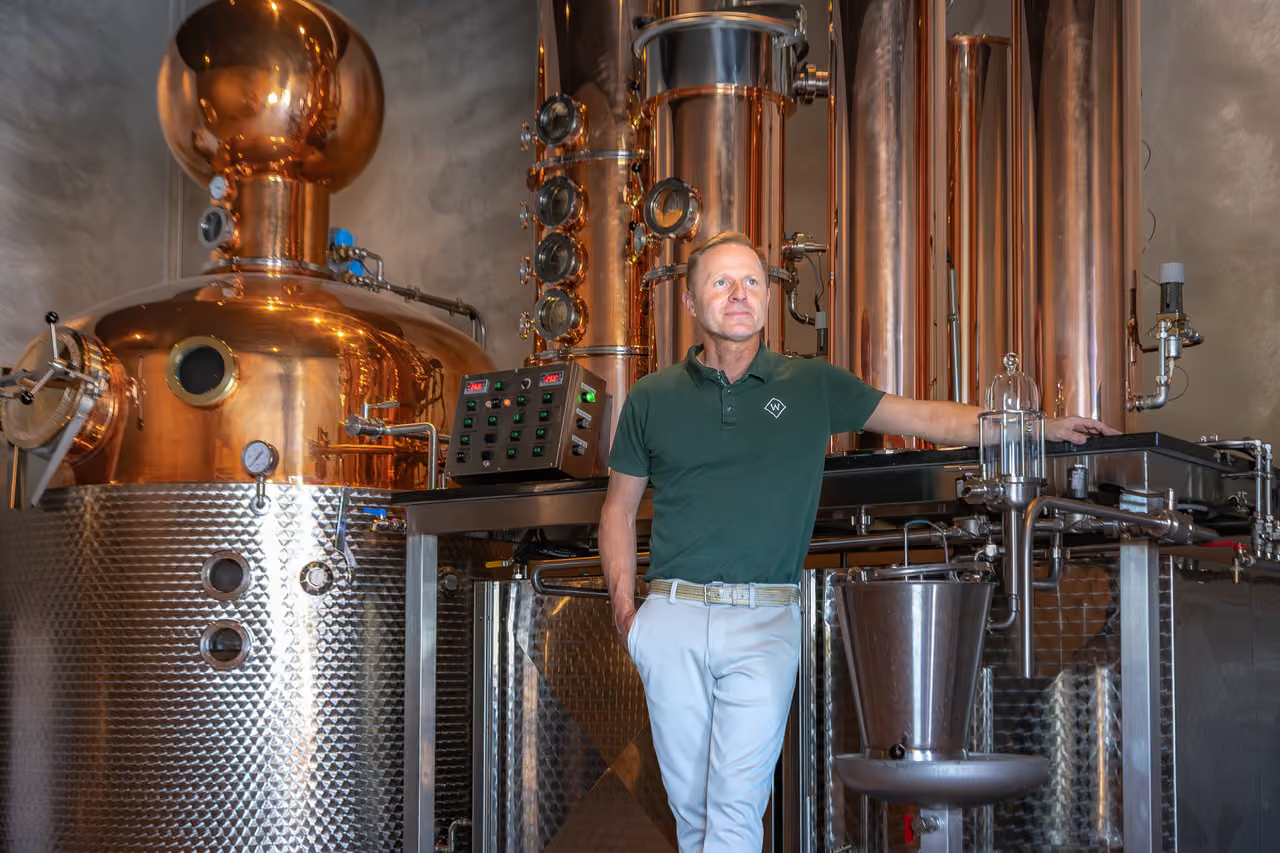
Food & Beverage

img/fb.avifimage unavailableA tasting at a production site
  • Producers and curators — spirits, wine, beer, chocolate, coffee — running tastings and tours at the production site or a curated venue.
  • The experience drives bottle sales, club signup and brand affinity. It's a means, not the end.
  • The heaviest B2B layer of any category — often more than half of experience revenue once corporate, private and venue are counted.
  • Production schedule constrains the calendar. Public hours cluster on Friday and the weekend.
  • Cross-border VAT matters, and alcohol discount rules bite in Sweden and Norway.

Biggest gap: everything after the ticket — bottle sales, clubs, and the B2B invoice.

Clause 2 · What shape

Read the operating model first

Not what industry they are in — how the transaction is shaped. Four checks, and all four have to hold.

Scheduled

There is a time slot.

Repeatable

The same thing runs again.

Catalog-based

A set of experiences, not one-off builds.

Publicly open

Any qualifying guest can book it.

Supporting signals: a live website, taking bookings online, operating for a year or more.

Clause 2 · The edges

Where we draw the line

In scope

  • Scheduled sessions, single or multi-day
  • Multi-session programmes with a fixed end
  • Open-hours admission with a daily cap
  • Venue and space reservation
  • Menu-based bespoke, built off a catalog

Out of scope

  • Subscription or membership access — the product is access, not a booking
  • Fully bespoke, no catalog — nothing repeatable to sell
  • Accommodation as the product
  • A named provider required first — you book a person, not a session
  • General admission — the value is entry, not a slot

Recurring classes are the one people ask about most, because we do have real customers there. They stay supported — we are just not going out to win more until the billing work is scheduled. Memberships are off-roadmap with no ship date, so don't promise it's coming.

Clause 3 · Where

Five markets

Denmark Norway Sweden Italy Spain

Anything outside these five is out — however good the fit looks on every other axis. This is the easiest clause to check and the one people most want to make an exception for.

Nordics are projected to reach roughly 69% of net-new potential by end of 2027. Italy and Spain run into 2030–31, which is why they are a longer game rather than a quick win.

Clause 4 · How complicated

How much surface do they carry?

Once the operating model holds, the second read is complexity. Fit does not fall off a cliff — it erodes as complexity grows.

  • How many locations?
  • How many staff or guides?
  • How many people in the buying decision?
  • What systems do they already run that we would need to integrate or migrate — ERP, HR, PMS?

A solo guide on Squarespace is low-complexity. A multi-location catering school on Business Central and Planday, with a buying committee, is high-complexity — at the same revenue. The full complexity model is still being built; until it is ready, we use business volume as the gate.

Clause 5 · How big

Complexity is the axis. Volume is a stand-in.

Seed
€0 – 50k
Take Off
€50 – 200k
Accelerate
€200k – 1M
Enterprise
€1M+ · usually out

Business volume is a hint that complexity is worth a closer look, because a bigger operator usually has more moving parts. It is not the gate itself. There is no revenue floor in the product ICP, and buyer structure never disqualifies on its own.

Why the axis moved

Two customers who break the size rule

Both sit far above anything we would once have called a ceiling. Both are customers we serve well.

Folkehuset Absalon

SELLS €2.23M A YEAR THROUGH US

Well past €1M, and a good fit — because the operational complexity is low and the product does what they need.

Bridgewalking

SELLS €1.52M A YEAR THROUGH US

Same story. Large by volume, straightforward to run, squarely inside what we build for.

Had we drawn the ICP on size, we would have excluded both. Size tells you how much an operator books. Complexity tells you whether we can serve them.

One ICP, many overlays

The ICP says who we can serve. Overlays say who a product works for.

There is one Understory ICP — the product ICP. On top of it sit functional overlays, one per product or motion. Every paid feature has a target audience somewhere inside the ICP, so the set of overlays grows over time.

The product ICP

WHO QUALIFIES AT ALL

Industry, operating model, complexity, market, product fit. Business Volume is deliberately excluded here.

An overlay

WHO ONE PRODUCT WORKS FOR

A set of rules for one product within the ICP. Overlays narrow. They never expand. No overlay can bring in an operator the ICP excludes.

This is why the ICP has no revenue floor but Sales-Led does. So when someone asks "is this customer in scope for Pay?", the first question is whether they are in the ICP at all.

The overlays today

Each one narrows differently

OverlayThe gateWhy that gate
Sales-LedBusiness Volume ≥ €25k, plus geography and spoken languageProtects CAC — below it, winning the customer doesn't pay back
PayOperational complexity, plus geographyComplexity proxies the payment agreement; geography decides currency and local methods
Meta AdsBloomBV ≥ €50k · INSTR and FB only · AOV ≥ €40 · under 80–90% occupancyCreates demand from a cold audience, so it needs headroom and order value. TOUR is effectively excluded — OTA dependency is structural
Google AdsCheckout revenue ≥ €25k Branded, ≥ €40k Smart · 30 bookings in 90 daysThe customer has to earn back a fixed monthly cost
ReviewsNo floor — open to the full ICPUsage-based pricing absorbs the range a fixed fee would have to exclude
WebsitesA judgment call: who is going to build this?Delivery capacity, not customer size, is the constraint
EmailNone yetConversion is unmeasured, and it swings break-even from 30 to 2,222 bookings a month
Two traps worth knowing early

Reading overlays correctly

Same number, different reason

Sales-Led and Google Ads Branded Search both sit at €25k. That's a coincidence. Sales-Led uses it to protect the cost of winning a customer; Google Ads uses it as the point where a customer earns back €189 a month.

They also measure different things — Sales-Led uses estimated total BV, Google Ads uses revenue observed through our checkout. Track them separately. If one moves, the other doesn't automatically follow.

A trait disqualifies. A lever doesn't.

Some criteria look like customer traits but are actually driven by our own product — consent rate, review collection rate, how much of a business has moved into our checkout.

If a customer fails on a real trait, they're disqualified. If one of our levers is underperforming, that's a roadmap item — not a reason to walk away from a customer we could serve.

Let's test it

Match or no match?

Six operators. For each one, decide before the answer appears — and say which rule decided it, not just yes or no.

Click or press → to reveal each answer.

Quiz · 1 of 6
A two-boat kayak tour operator on the Douro in Porto. Daily scheduled departures from a fixed meeting point, sells through GetYourGuide and its own site, around €120k a year, run by the founder.

Decide, then reveal →

No match
Decided by · Market

A textbook TOUR operator in every respect except one: Portugal is not among DK, NO, SE, IT, ES. Right business, wrong map — and this is the near-miss you'll see most often.

Quiz · 2 of 6
A yoga studio in Copenhagen. Classes run on a published weekly schedule, bookable online. Sells ten-class packs and a monthly membership. Around €180k a year.

Decide, then reveal →

No match
Decided by · Operating model

Two failures. Membership is access, not a booking. And a class you come back to each week isn't finished in one sitting — that's the exact line separating a workshop from a recurring class.

Worth remembering: memberships are off-roadmap with no planned date. This isn't "not yet".

Quiz · 3 of 6
A gin distillery in Skåne. Tasting-room tours Friday to Sunday on a published schedule, a bottle club, around €300k a year. Also wants to rent the barn out for weddings.

Decide, then reveal →

Match With a flag
Decided by · Category fit

A producer hosting tastings on-site is core FB — sell it. The wedding-venue layer is the sub-category we watch rather than build for: if unrelated venue hire becomes the main event, fit erodes.

Not every answer is binary. "Yes, and keep an eye on X" is a real outcome.

Quiz · 4 of 6
A sports massage clinic in Oslo. Customers pick their therapist, then choose a 60-minute slot in that therapist's calendar. Around €90k a year, bookable online, live site, five years old.

Decide, then reveal →

No match
Decided by · Booking unit

The booking requires a named individual before a time can be chosen. Our unit is a scheduled slot open to any qualifying customer. Everything else here looks fine, which is what makes it a good trap.

Quiz · 5 of 6
A cooking school in Milan. Four locations, around €1.4M a year, runs Business Central for finance and Planday for staff. The decision involves an ops lead, a CFO, an IT contact and the founder.

Decide, then reveal →

No match
Decided by · Size and complexity

Enterprise on business volume — but that is not what decides it. The real problem is complexity: multiple entities, and legacy systems that would need integrating or migrating.

Note what did not decide it. Not the four stakeholders — buyer structure is context, never a disqualifier. And not the €1.4M: we serve customers well past that.

Quiz · 6 of 6
A pottery studio in Aarhus, around €30k a year. Public workshops on a published calendar, average order value about €65. Solidly in the ICP. Sales asks whether they can attach Bloom.

Decide, then reveal →

In the ICP Not for Bloom
Decided by · Overlay

They clear the product ICP and the Sales-Led floor of €25k. But Bloom needs €50k in Business Volume, so this operator sits inside the ICP and outside that overlay.

"In the ICP" never means "qualifies for everything we sell." Check the overlay for the specific product.

The whole thing, in five checks

What to run through

  • One of the three categories — tours, workshops, or food & beverage
  • Selling something scheduled and catalog-based, open to any customer
  • Operating in Denmark, Norway, Sweden, Italy or Spain
  • Seed through Accelerate — under €1M, with no floor in the product ICP
  • Low-to-medium operational complexity — the axis that actually predicts fit

Fail any one and it isn't our ICP, however good the rest looks. Then, separately: check the overlay for whichever product you're proposing.

Don't over-trust these bits

What's still in motion

Open itemWhere it stands
Complexity modelThe real fit signal, but the framework for inferring it from public information is still being built. Business Volume stands in until it lands.
BV & segment modelSegments are assigned by hand today, from a rep's estimate. A data-driven model is in build.
Per-package minimum priceThe H2 pricing project, expected end of Q3 or in Q4. It's what lets Seed stay in scope without a revenue floor.
HubSpot taxonomyIndustry values in HubSpot don't yet mirror the ICP doc, so the two can disagree.
WineriesDeliberately paused until H1 2027. Italian food producers are in scope now.

The ICP is a living document on a roughly weekly cadence. Where it says TBD, it genuinely means TBD.

Where to go next

Looking it up, and who to ask

The documents

Who to serve (ICP) — the canonical definition.
ICP profiles — firmographics, pains, capabilities per category.
ICP Overlays V1 — every overlay and its thresholds.
Segments × Value Props × Capabilities — the Alignment² map.

The people

Lars & Sari — product: definitions, category profiles, who qualifies.
Christian — overlays and pricing.
Harboe — growth and lead sourcing.
Kjær — sales playbook and enablement.
Cecilie — customer success. Joakim — RevOps and ICP scoring.

If the ICP and a system disagree, the ICP document wins — and tell whoever owns that section.

Understory · Who we serve